

IUD out of place symptoms, such as sudden, severe pain, heavy bleeding, or being unable to feel the strings, may signal that the intrauterine device (IUD) has shifted from its original position. After an IUD insertion, whether you have a hormonal IUD, like Mirena IUD, or a copper IUD, recognizing the signs of IUD displacement and IUD expulsion is critical for preventing pregnancy and avoiding serious health complications. If you suspect your IUD has moved, contact a healthcare professional immediately. Additionally, if you’ve suffered from a defective intrauterine device (IUD), contact the national defective medical device attorneys at Reich & Binstock.
Call 713-622-7271 to schedule a free consultation.
What Causes an IUD to Move?
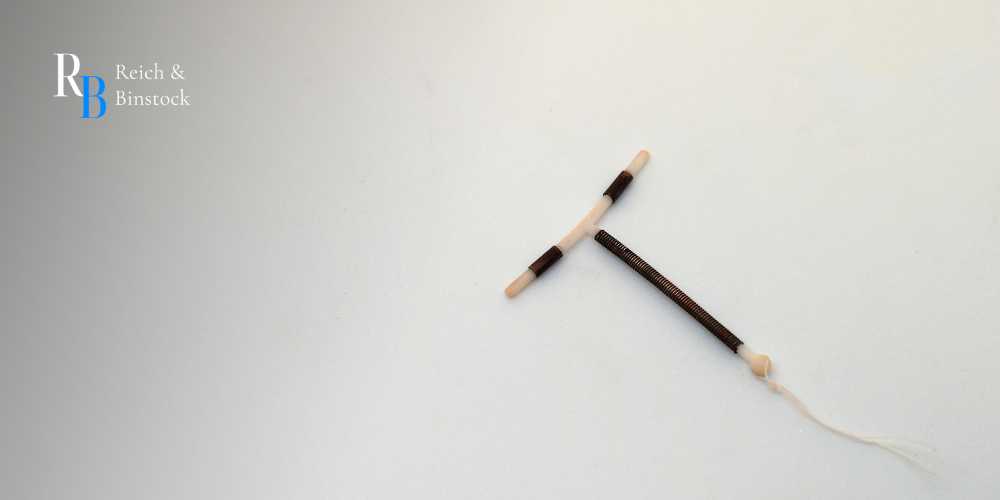
Intrauterine devices can move due to uterine contractions, IUDs inserted incorrectly, or anatomical issues like fibroids that change the shape of the uterus. Physical activity, sex, or even heavy lifting shortly after the intrauterine device is inserted also increases the risk of IUD displacement. Recent childbirth, insertion during postpartum, and a tilted uterus can further raise the risk.
Can Sex Move an IUD?
Sex does not typically cause intrauterine devices (IUD) to move, but it may contribute to IUD displacement, especially if the device was not inserted properly or if it’s early in the first few months after placement. Pressure during intercourse may irritate the cervix or uterus if the IUD has moved, and a partner feels the strings or plastic edge of the T-shaped device. If you experience pain during sex, bleeding, or a sudden inability to feel the IUD strings, it’s important to contact a healthcare professional to check the device’s position.
Can an IUD Fall Out?
Yes, an IUD can fall out, especially if it’s defective. A displaced IUD can move from its intended position inside the uterus, potentially causing pain, injury, or ineffective contraception. If you suspect that your IUD has moved, it’s crucial to contact your doctor immediately to assess the situation and prevent further complications.
IUD Falling Out Symptoms
Signs your t-shaped device is falling out can include:
- Sudden cramps or sharp pain
- Heavy bleeding
- Feeling the copper or hormonal IUD in the vaginal canal
- Being unable to feel the IUD strings
- A partner feels the plastic part during sexual activity
- Discharge or fever
- Feeling the hormonal or copper IUD partially expelled or visibly outside the body
If you experience this, use another form of birth control and contact your healthcare professional to confirm whether the IUD has moved or been expelled.

If My IUD Moved, Can I Get Pregnant?
Yes, if a copper IUD or hormonal IUD traveled from its correct position in the uterus, you could get pregnant. IUD displacement, whether partially expelled or fully fallen out, may no longer block sperm effectively or release hormones properly. This increases the risk of unplanned pregnancies.
Symptoms of IUD Moving
Mirena IUD Moved Out of Place Symptoms
Signs your Mirena IUD is not in place include:
- Unable to feel the strings of your Mirena IUD with one finger
- Cramping or severe pain in the lower abdomen
- Feeling the Mirena IUD near the vaginal opening
- A partner feels the Mirena IUD during sex
- Sudden change in your menstrual cycle
- Infections (fever, chills, or unusual discharge)
If you experience any of these Mirena side effects, stop using Mirena IUD for pregnancy control, and contact your healthcare professional. Then speak with our Texas Mirena IUD injury lawyers for a free consultation.
Liletta IUD Moved Out of Place Symptoms
If your Liletta is out of place, you may notice:
- Inability to feel the Liletta IUD strings
- Abdominal pain
- Changes in menstrual cycle
- Feeling the Liletta in the vaginal canal
- A partner feeling the Liletta during sexual activities
- Infections (fever, chills, or unusual discharge)
If you suspect your Liletta has moved, schedule an exam with your healthcare provider to check for IUD displacement or expulsion.
Kyleena IUD Moved Out of Place Symptoms
If your Kyleena moved out of place, symptoms may include:
- Inability to feel the IUD strings
- Cramping or sharp abdominal pain
- Feeling the plastic Kyleena in or near the vagina
- A partner can feel the Kyleena during intercourse
- Sudden changes in menstrual flow
- Fever, chills, or other signs of infection
If you notice any of these, contact a healthcare professional to check for IUD displacement, expulsion, or other complications.
Signs Your Paraguard is Out of Place
If your Paraguard is out of place, you may notice:
- You can’t feel the IUD strings with your finger
- Cramping or sharp pain
- Heavier periods or new spotting
- Feeling the copper IUD in the vaginal canal
- A partner feeling the device during intercourse
- Fever or unusual discharge signaling possible infection
If you suspect Paragard has moved, contact your doctor to check for IUD expulsion, displacement, or uterine perforation.
Signs Your IUD Is Out of Place
If you observe any of the following signs of IUD expulsion or movement, contact your doctor:
- IUD strings could be up inside your uterus if you can’t find them.
- It may have shifted if the IUD strings are shorter or longer than before. You should only feel the IUD strings, not the plastic portion.
- If your partner can feel the hard plastic while being intimate, movement is possible.
- If 3-6 months after the IUD insertion, you’re still in pain.
- Unusual or excessive bleeding could indicate uterine perforation
It is entirely possible for women to experience nothing when IUDs move. Regularly checking your IUD strings is key.
How Do I Know if My IUD is Out of Place?
To make sure your IUD is still in the right spot, follow these steps:
- Wash your hands.
- Insert one finger into your vagina until you contact the cervix. Like the tip of your nose, this will feel stiff and rubbery.
- You should be able to feel the IUD strings. The contraceptive is likely doing its job if you can feel the strings in the right place.
- If the IUD strings feel longer or shorter than they did the last time you checked them, or if you can feel the hard section of the plastic against your cervix, it may have shifted. You’ll need your healthcare professional to put it back in place.
Use a different form of birth control until you see your doctor if you’re concerned your IUD has moved. You may be asked to take a pregnancy test. If the IUD strings can’t be found during a pelvic exam, a pelvic ultrasound may locate it if IUD expulsion hasn’t occurred.
How to Check IUD Strings for Intrauterine Device (IUD) Displacement
IUD Strings Hanging Out of Cervix
If your IUD strings are hanging out of the cervix, it may be a sign of a partial expulsion or IUD displacement. Normally, IUD strings should extend just slightly into the vaginal canal and feel firm but not visible outside the body. If you see or feel more IUD string than usual, or if the plastic part is detectable, contact your doctor to check the device’s position and prevent complications.
Can’t Feel the IUD Strings
If you can’t feel the IUD strings, it may mean:
- The strings have curled up into the cervix or uterus, which is normal
- The IUD has shifted or moved out of place
- It is partially expelled or fully expelled
- Your uterus was perforated during insertion
IUD Strings Feel Longer
If your IUD strings feel longer than usual, it could mean that the IUD moved, is being expelled, or has moved lower in the uterus.
Can't Feel IUD Strings and Cramping
If you can’t feel your IUD strings and are also experiencing cramps, it may indicate that the IUD has moved, is partially expelled, or in rare cases, caused uterine perforation. Cramping alone can be normal after insertion, but when combined with missing IUD strings, it warrants evaluation.
Signs Your IUD Has Moved and Displaced IUD Symptoms
Mirena is one of the more popular forms of IUD. The Mirena IUD is placed where the uterus meets the fallopian tubes, much like other IUDs. Some of the symptoms of Mirena IUD movement include the following.
- Not being able to feel the strings
- IUD strings that are shorter or longer than usual
- Feeling the IUD itself rather than feeling the strings
- Feeling pain
- Having heavy or abnormal bleeding
- Having severe cramping, abnormal discharge, or fever
Can a Displaced IUD Cause Back Pain?
Yes, a displaced IUD can cause back pain. This may present as dull pelvic discomfort that radiates to the lower back and may worsen with movement or sex.
Signs of IUD Infection
Signs of an IUD infection may include:
- Fever or chills
- Lower abdominal pain or cramping
- Foul-smelling vaginal discharge
- Painful intercourse
- Bleeding between periods
- Unusual vaginal discharge
- General discomfort or pelvic tenderness
These symptoms may develop shortly after IUD insertion or if the IUD has moved. Prompt evaluation by a healthcare professional is critical to prevent serious complications like pelvic inflammatory disease.
IUD Embedded in Uterus Symptoms
If an IUD moves out of place, it may embed itself into the uterine wall. Symptoms of an IUD being embedded in the uterus include the following.
- Persistent cramping or pelvic pain
- Bleeding problems or irregular periods
- Pain during sex
- Inability to feel the strings
- Abnormal discharge or signs of infection
- Positive pregnancy test if the IUD is no longer effective
If an intrauterine device (IUD) goes into the uterine wall, it may lead to serious complications. Diagnosis typically requires a pelvic exam and ultrasound.
IUD Perforation Symptoms
Perforation usually occurs at the time of insertion and is rare, with a reported incidence of 0.1%–0.3%. It is more likely during postpartum or breastfeeding. What are the symptoms of IUD perforation? While many cases are asymptomatic, signs of perforation include:
- Persistent pelvic or abdominal pain more severe than typical cramping
- Abnormal vaginal bleeding or changes in menstrual flow
- Inability to feel the IUD strings, or strings that seem longer or shorter than usual
- Pain during sex
- In rare cases, fever, nausea, or signs of infection if the IUD migrates outside the uterus
Evaluation typically involves ultrasound, and removing it may be necessary to avoid further complications.
Expired IUD Symptoms
It is also possible for an IUD to expire and need replacing. If your IUD is expired or defective, you may experience the following symptoms.
- Return of regular menstrual cycles after a period of absence or light periods
- Increased cramping or pelvic discomfort
- Heavy bleeding or prolonged periods
- Spotting between periods
- Decreased effectiveness in preventing pregnancy
- Changes in vaginal discharge or color
Once an IUD expires, its ability to prevent pregnancy declines. If you suspect your IUD is no longer effective, ask your healthcare professional to remove it and to discuss inserting a new IUD.

When to Contact a Healthcare Professional for IUD Birth Control Health Complications
Call your doctor immediately if you have signs that your IUD is out of place. If you’re sexually active, use your backup birth control method to avoid a pregnancy. Wait to have sex until you see your doctor if you’re in pain. Emergency contraception may be needed if you’ve had sex recently.
Serious harm or infection can happen if you try to push your IUD back into place or remove it yourself. This can also make the IUD less effective. If you’re worried that the IUD is not in the right place, use a backup birth control method until your doctor says it’s okay to go without it.
Experienced Houston IUD Injury Lawyers
Have you been hurt by an IUD birth control device? Were you denied medical help after signs that your IUD is out of place? Please contact our Houston personal injury attorneys for a confidential, free consultation regarding your legal options by calling 713-622-7271. We represent clients nationwide who have been injured by defective methods of birth control, such as IUDs. We handle claims for IUD hair loss and personal injuries caused by malpractice or defects.